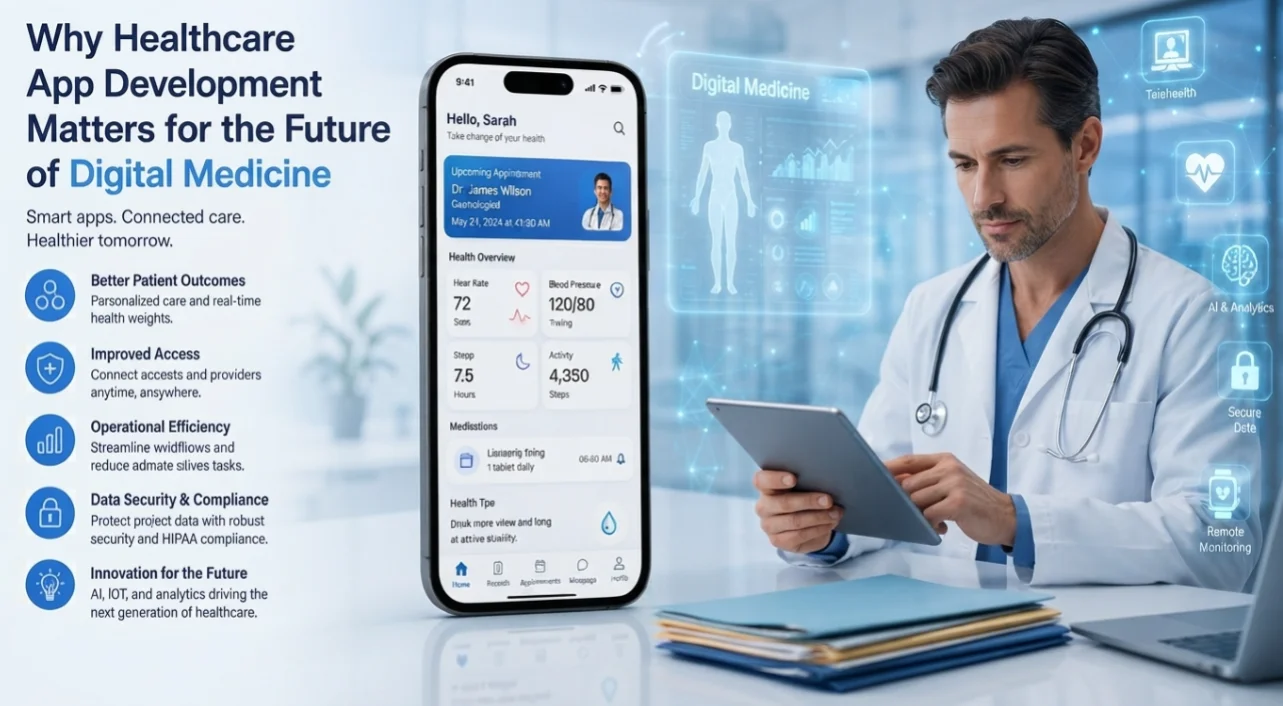
Why Healthcare App Development Matters for the Future of Digital Medicine
A patient in a rural town used to wait three weeks for a specialist appointment that was two hours away by car. Now a lot of that same visit happens over video, with lab results already synced into the app before the call even starts. That shift didn’t happen on its own it took a serious Healthcare App Development Company treating medical software as infrastructure, not a side project bolted onto a hospital’s website.
Digital medicine isn’t a buzzword anymore. It’s the actual delivery mechanism for a growing share of care, from chronic condition management to mental health support to post-surgical follow-ups that used to require an in-person visit just to check a wound was healing. Here’s why the apps behind all of this matter more than most people realize, and where the field is actually headed.
From Paper Charts to Real-Time Patient Data
Healthcare ran on paper and fax machines for longer than almost any other industry, and the lag cost lives. A specialist making a decision without a patient’s full history isn’t practicing medicine as well as they could be they’re guessing with partial information.
Modern healthcare apps pull records, lab results, and medication histories into one place, updated as new data comes in rather than days later. A cardiologist reviewing a patient’s data mid-appointment sees the same numbers a primary care doctor saw that morning. That kind of continuity used to require phone calls between offices and a lot of patience. Now it’s just how the system is supposed to work, when it’s built right.
Remote Monitoring Changed What “Check-In” Means
Wearables and connected medical devices feed data straight into healthcare apps now heart rate, glucose levels, blood pressure, sleep patterns. A diabetic patient’s glucose trend can trigger an alert to their care team before a dangerous spike turns into an ER visit.
This matters most for chronic disease management, where small daily numbers add up to big outcomes over months. A doctor doesn’t need to wait for a quarterly appointment to catch a problem anymore. The data’s already there, flagged, waiting for a five-minute phone call instead of a crisis.
Telehealth Stopped Being a Pandemic Workaround
Telehealth exploded out of necessity a few years back, and a lot of people assumed it would shrink once in-person visits became easy again. It didn’t. Patients kept using it because it solved a real problem getting specialist care without a half-day off work and a long drive.
The apps that stuck around are the ones that treated video visits as one part of a bigger system, not the whole product. Scheduling, prescription routing, follow-up messaging, insurance verification all of it needs to work together, or the video call itself becomes the easy part surrounded by friction on every side.
AI Is Doing More Than Scheduling Reminders
Machine learning in healthcare apps has moved well past appointment reminders and basic symptom checkers. Predictive models now flag patients at high risk of readmission before they’re even discharged. Image recognition tools help radiologists catch things a tired eye might miss on the two-hundredth scan of the day.
None of this replaces a doctor’s judgment, and it shouldn’t try to. What it does is surface the cases that need a second look faster, which matters enormously in a system where clinician time is the scarcest resource there is.
Interoperability Is the Unglamorous Problem That Actually Matters
Ask anyone who’s worked in health tech what the hardest part of the job is, and most won’t say AI or UI design. They’ll say getting one hospital’s system to actually talk to another hospital’s system. Standards like FHIR (Fast Healthcare Interoperability Resources) exist specifically to solve this, letting apps pull and share patient data across platforms that were never built to cooperate.
An app that can’t exchange data with a hospital’s existing EHR system is a dead end no matter how polished its interface looks. Interoperability isn’t exciting to talk about, but it’s the difference between an app that fits into a patient’s actual care journey and one that becomes another disconnected login nobody bothers to check.
Security Carries More Weight Here Than Almost Anywhere Else
Medical data is about as sensitive as personal information gets, and HIPAA compliance in the US (with equivalent frameworks like GDPR’s health data provisions elsewhere) isn’t optional or negotiable. A breach doesn’t just mean embarrassment for a company it means real people’s diagnoses, medications, and mental health records exposed.
End-to-end encryption, strict access controls, detailed audit logging these aren’t features to bolt on later. They have to be part of the architecture from the very first line of code, because retrofitting security into a healthcare app after launch is close to impossible to do properly.
Where the Field Is Actually Headed
Looking across 10 healthcare app trends shaping the industry right now AI-assisted diagnostics, remote patient monitoring, mental health platforms, voice-based clinical documentation, wearable integration, personalized treatment plans, chronic care management tools, interoperable EHR access, virtual nursing support, and value-based care tracking a clear pattern emerges. The winners aren’t chasing novelty for its own sake. They’re solving specific friction points that made care slower, more expensive, or harder to access than it needed to be.
Accessibility Determines Who Actually Benefits
A brilliant healthcare app that only works for tech-savvy 30-year-olds misses a huge share of the patients who need it most older adults managing multiple conditions, people with limited digital literacy, patients in areas with unreliable internet access. Large text options, voice navigation, offline functionality for spotty connections, and multilingual support aren’t extras. They determine whether the app actually reaches the population it was built for.
The Bigger Picture
Healthcare app development isn’t about digitizing paperwork for its own sake. It’s about closing the gap between when a problem starts and when someone actually gets help catching a glucose spike before it’s an emergency, connecting a rural patient to a specialist without a four-hour drive, giving a clinician the full picture instead of a fragment of one. The technology matters because the outcomes attached to it are real, and getting the engineering right is, in a very literal sense, a matter of patient safety.